I · MEDICINE · 1974
Opening: Medicine and the foreign-policy instinct
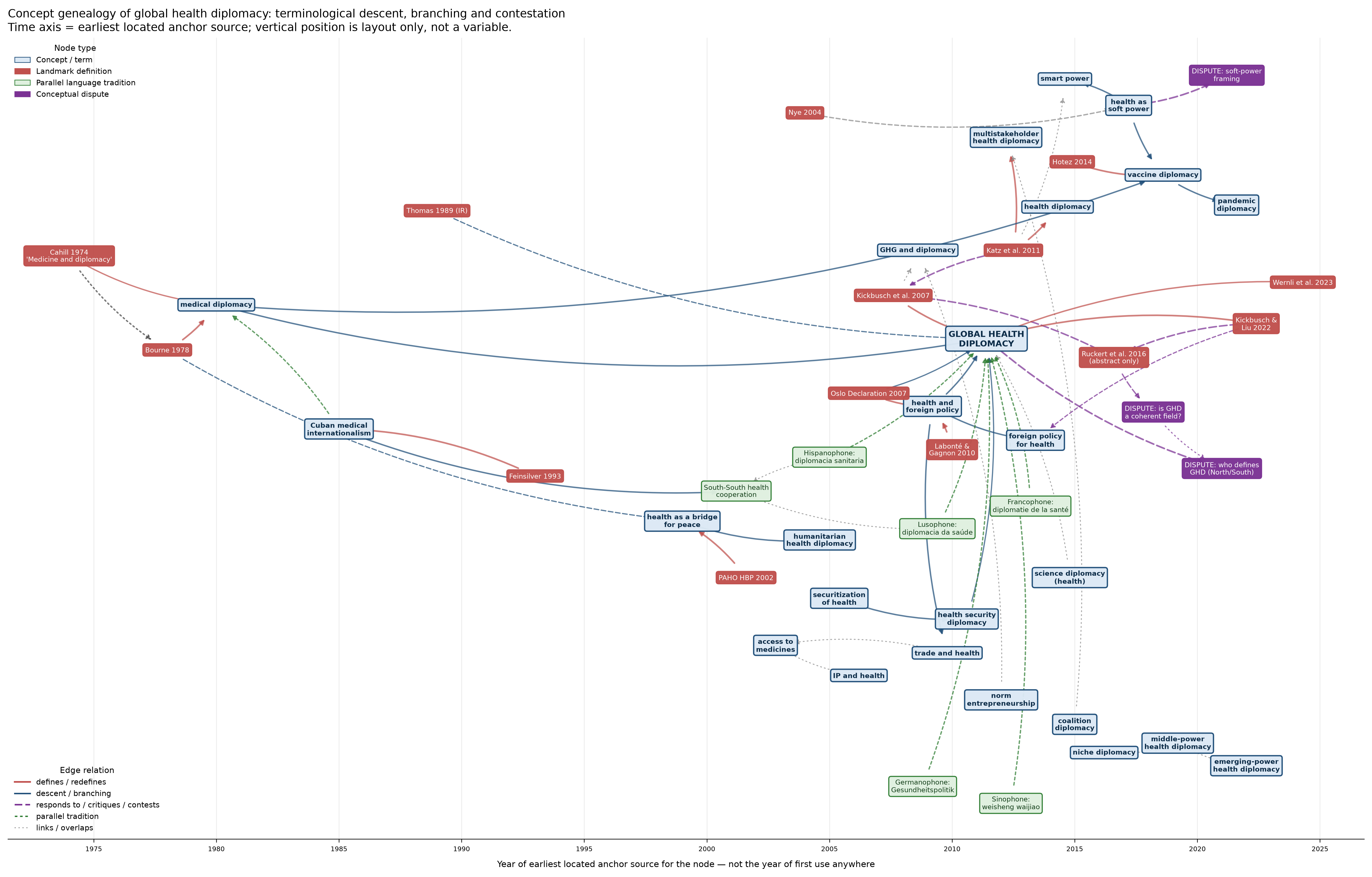
The field did not begin as a settled term. In 1974, Kevin Cahill's editorial paired medicine and diplomacy in its title. No document in this corpus cites it.
Visual argument · concept genealogy
Tracing the terms, traditions and disputes that came to define a field.
Earliest located anchor year →
World / institutions
The field did not begin as a settled term. In 1974, Kevin Cahill's editorial paired medicine and diplomacy in its title. No document in this corpus cites it.
Medicine was already being described as something that could cross political borders, serve foreign-policy purposes, and shape relations between states.
Peter Bourne's argument that health services could improve international relations became the origin point often cited later, usually at second hand through Katz and colleagues in 2011.
Cuban medical internationalism, Feinsilver’s analysis of Cuban cooperation, and Caroline Thomas’s work on health in International Relations show that the early genealogy was already plural.
In the late Cold War and post-Cold War period, health was increasingly imagined not only as assistance across borders but as an explicit means of producing or maintaining political relations.
The concept emerged in PAHO and WHO initiatives during conflict resolution in Central America, later evaluated by de Quadros and Epstein in 2002.
South-South health cooperation developed from Cuban medical internationalism. It enters this movement as a parallel practice, not as a simple descent from one anglophone term.
Humanitarian health diplomacy grows beside this branch. Health was no longer only technical medical assistance; it became a language for negotiating peace and building diplomatic solidarity.
Around the turn of the century, international health crises and economic agreements forced health into high-level multilateral negotiations.
The WTO Doha Declaration on TRIPS and Public Health and the UN Special Session on HIV/AIDS established intellectual property and access to medicines as core diplomatic battlegrounds.
At the same time, securitization transformed how states viewed disease outbreaks. Health became an interdependent cross-border issue that formal diplomacy had to manage.
In 2007, earlier trajectories began to converge around a stabilizing name. The Oslo Ministerial Declaration placed health firmly within foreign-policy agendas.
The policy vocabulary did not replace earlier practices. It offered a point at which health and foreign policy could be named together and carried forward.
Kickbusch, Silberschmidt and Buss framed global health diplomacy as a multi-level negotiation process, while global health governance expanded alongside diplomacy.
The argument is not that global health diplomacy suddenly appeared in 2007. A unified terminology began to organize practices that had developed through earlier medical, humanitarian, security, and trade traditions.
Definitions expanded through Labonté and Gagnon’s policy frames and Katz and colleagues’ taxonomy of core, multistakeholder, and informal diplomacy.
When health diplomacy became global, did everyone mean the same thing? The dataset records six tradition nodes: five language lineages alongside South-South health cooperation.
These language nodes attach to global health diplomacy through parallel_tradition edges, rather than direct descent. They are not mere literal translations of an English concept.
As the field expanded, scholarly focus shifted from asking what global health diplomacy is toward asking how actors deploy health to project power.
Soft power branched into smart power, niche diplomacy, middle-power health diplomacy, emerging-power health diplomacy, and multistakeholder diplomacy.
This vocabulary exposes a tension between cooperative global health goals and competitive state strategy. Science diplomacy enters the map as another supported attachment.
The COVID-19 pandemic accelerated the visual rhythm of the genealogy. Vaccine diplomacy expanded from 8 pre-2020 records to 164 afterwards, while pandemic diplomacy emerged exclusively post-2020.
Three fundamental disputes sit at the structural core: whether global health diplomacy is a coherent field, whether the soft-power framing survives critique, and who is entitled to define the term.
What appears today as a single field is the sediment of several histories. The complete genealogy now remains open for exploration, with its sources and limits intact.
Recurrence measured by citation linkage rather than text matching: Corpus A records with a usable DOI that cite each definitional work, over a denominator of 2,066. The 408 Corpus A records without a DOI cannot be linked and are excluded rather than counted as non-citing. Corpus B and C are never pooled in.
| Definitional lineage | Year | Global citations (OpenAlex) | Citing works in Corpus A | Denominator | Share |
|---|---|---|---|---|---|
| Kickbusch, Silberschmidt & Buss 2007 - GHD as multi-level, multi-actor negotiation | 2007 | 254 | 110 | 2066 | 5.32% |
| Katz et al. 2011 - core / multistakeholder / informal taxonomy | 2011 | 147 | 89 | 2066 | 4.31% |
| Labonte & Gagnon 2010 - six policy frames for health in foreign policy | 2010 | 231 | 79 | 2066 | 3.82% |
| Hotez 2014 - vaccine diplomacy: historical perspectives | 2014 | 113 | 60 | 2066 | 2.90% |
| Ruckert et al. 2016 - critical review; IR levels-of-analysis taxonomy | 2016 | 71 | 39 | 2066 | 1.89% |
| Kickbusch & Liu 2022 - reconstructing power and governance | 2022 | 124 | 38 | 2066 | 1.84% |
| Feinsilver 2010 - fifty years of Cuba's medical diplomacy | 2010 | 99 | 18 | 2066 | 0.87% |
| Chattu et al. 2021 - COVID-19 vaccine, TRIPS and GHD (India) | 2021 | 64 | 18 | 2066 | 0.87% |
| Feinsilver 1989 - Cuba as a 'world medical power' | 1989 | 80 | 4 | 2066 | 0.19% |
| Wernli et al. 2023 - WHA resolutions as a normative network | 2023 | 7 | 1 | 2066 | 0.05% |
Four caveats bind every row. Citation of a definition understates its adoption, because uncited paraphrase is invisible here. OpenAlex citation coverage is incomplete. Recency suppresses the most recent entries mechanically, so Wernli et al. at one citing work is a 2023 paper rather than a rejected definition. And a citation may be for a work's evidence rather than for its definition.
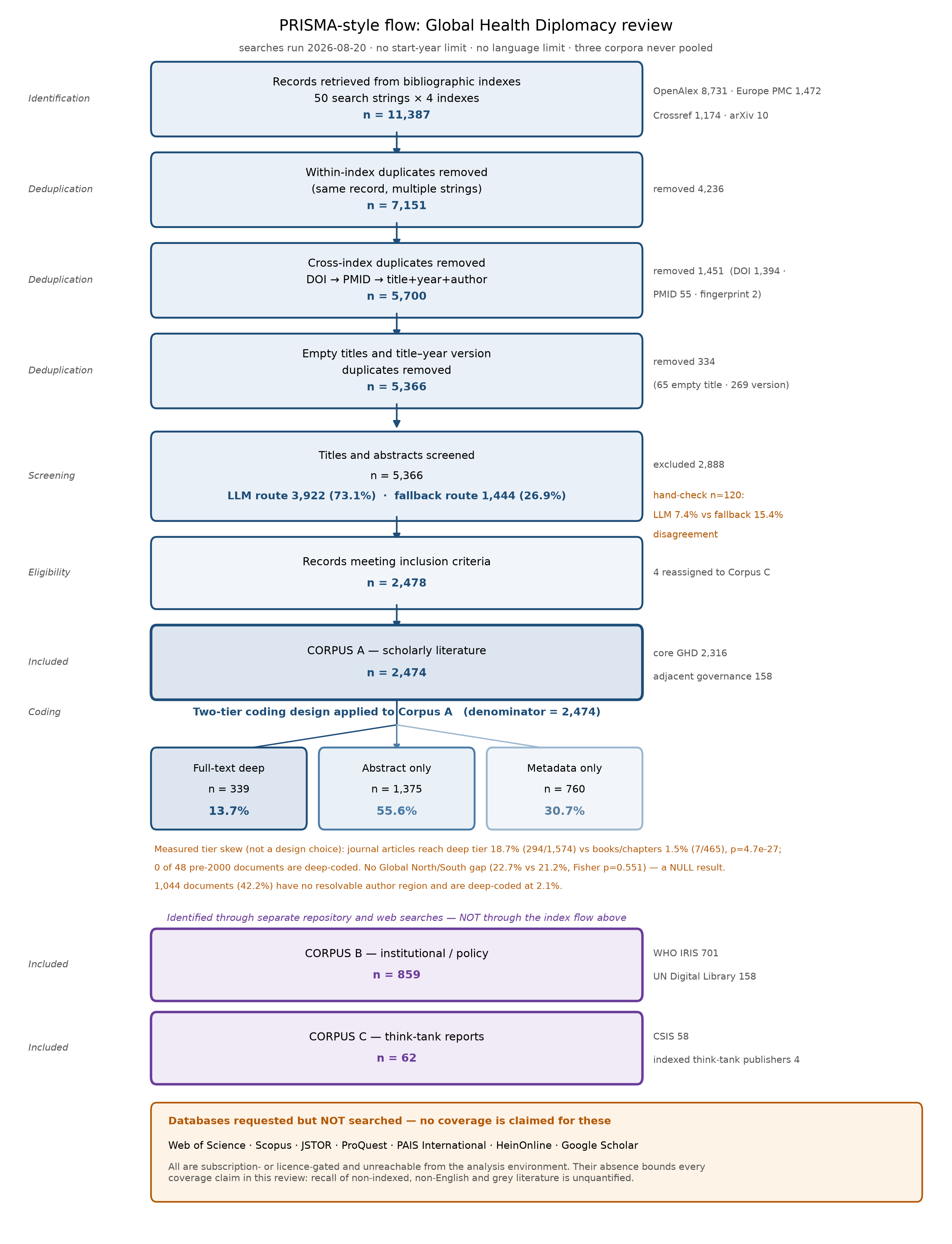
The genealogy is only as good as the search behind it. This is the flow with the counts that
produced each stage. The full narrative, including every access failure, is in
methodology/STAGE2_CONCEPTS_METHODS.md.
| Stage | n | Detail |
|---|---|---|
| Records retrieved from bibliographic indexes | 11,387 | 50 search strings across OpenAlex 8,731, Europe PMC 1,472, Crossref 1,174, arXiv 10 |
| After within-index deduplication | 7,151 | 4,236 removed as the same record hit by several strings |
| After cross-index deduplication | 5,700 | 1,451 removed by DOI, PMID or fingerprint match |
| Screening frame | 5,366 | 65 empty titles and 269 title-year version duplicates removed |
| Included at title and abstract screening | 2,478 | 2,888 excluded; hand-check of 120 gives 90.8% agreement |
| Corpus A, scholarly literature | 2,474 | core GHD 2,316, adjacent governance 158 |
| Corpus B, institutional and policy | 859 | WHO IRIS 701, UN Digital Library 158, searched separately and never pooled with A |
| Corpus C, think-tank reports | 62 | CSIS 58, indexed think-tank publishers 4 |
The Zenodo record (Version 1.0; DOI: 10.5281/zenodo.22127805) contains the coded literature and structured outputs used to reconstruct this genealogy. These materials make the coding and genealogical reconstruction inspectable and reusable for examining concepts, definitions, terminological lineages, or conducting alternative analyses.
data/concept_genealogy_nodes.csvNodes with node_id, label, node_kind, year_located, anchor_source and anchor_note. The year is an anchor date.
data/concept_genealogy_edges.csvDirected edges, each carrying a rationale and an evidence_identifier. One edge is flagged as an analytical inference.
data/concept_genealogy.graphmlThe same graph for Gephi, Cytoscape or NetworkX.
data/concepts_definitions.csvExtracted definitions with 29 fields each, including unit_of_analysis and evidence_source. A sample, not a census.
data/concept_attribute_evidence.csvPer-concept counts: phrase-verified, strict-title screen, earliest located work, median year, share from 2020.
data/definition_recurrence_ranked.csvCitation-linkage recurrence for ten definitional lineages against the DOI-linkable Corpus A denominator.
data/temporal_trends.csvPublication volume, concept prevalence, actor-type entry and frame shift, each with its denominator.
data/documents.csvEvery corpus record with its 41 metadata and coding fields.
data/screening_decisions.csvEvery screening decision with its route and rationale.
data/search_log.csvEvery search string, index, date and count.
data/prisma_counts.jsonThe counts behind the PRISMA figure.
data/corpus_bias_metrics.csvLanguage, author region and document-type composition with explicit denominators.
docs/data/genealogy.jsonThe web build, generated by scripts/build_site_data.py. The page reads only this.
docs/data/chapters.jsonThe essay text and the node focus for each chapter.